
AI Talker Review: A Plain-English AI Voice Designer That Tries to Turn Voice Content Into a Real Side Hustle
AI Talker Review: A Plain-English AI Voice Designer That Tries to Turn Voice Content Into a Real Side Hustle
Nov 30, -0001
AI Talker Review: A Plain-English AI Voice Designer That Tries to Turn Voice Content Into a Real Side Hustle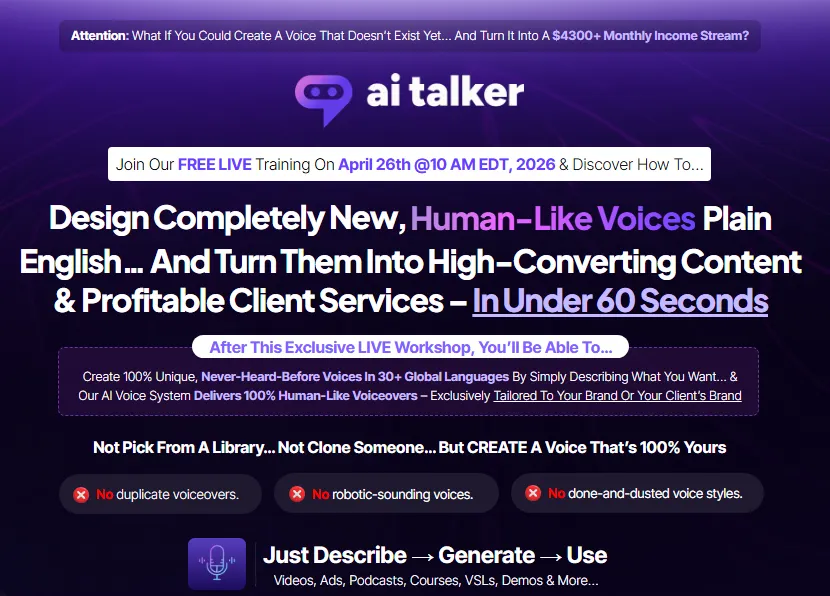
Affiliate disclosure: This post contains affiliate links. If you buy through my link, I may earn a commission at no extra cost to you.
Quick take
| Item | Details |
|---|---|
| Product | AI Talker |
| Type | AI voice designer / voiceover creation tool |
| Best for | Creators, freelancers, coaches, agencies, side hustlers |
| Main angle | Create custom voices from plain English, then use them for content or client work |
| Current front-end price | $37 at the time of writing |
| My link | AI Talker Review |
If you want the short version, here it is:
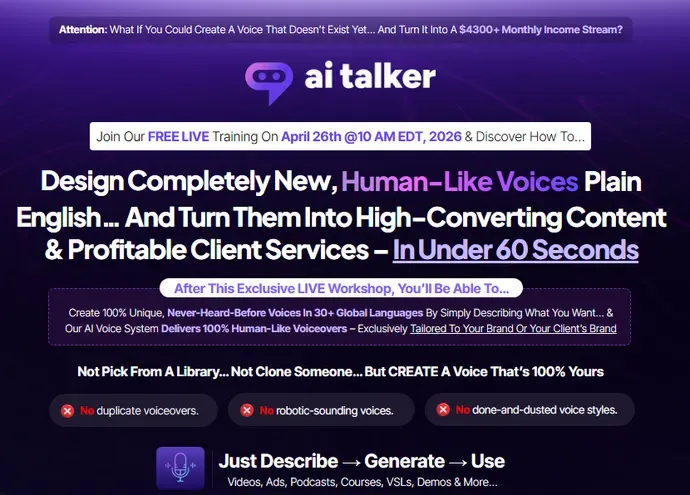
AI Talker is trying to do something smarter than just giving you another text-to-speech box. It wants to help you design voice content fast, package it for clients, and use it as a real business asset.
That part matters.
A lot of people in the MMO space don’t want another toy. They want a tool that helps them move faster, serve clients, or build a side hustle without getting buried in edits, software tabs, and endless trial-and-error. AI Talker is aimed right at that pain point.
It is not trying to be a simple “pick a voice from a library” app. It is trying to sit in a different lane. A lane where you describe the voice you want, shape the emotion, build a voice asset, and move on with your day.
That is the pitch.
And if you’ve been around online marketing long enough, you already know the pitch is only half the story. The real question is whether the product gives you a practical edge, or just a louder sales page.
That’s what this review is here to answer.
What AI Talker is really trying to solve
Let’s start with the part most people feel but don’t always say out loud.
Making voice content is annoying.
Not the idea of it. The actual work.
You have a script in one place.
A voice tool in another.
Music in another tab.
Maybe an editor somewhere else.
Then you still have to clean up timing, tone, pacing, and all the tiny things that make audio sound decent.
That’s where a lot of people get stuck.
They don’t get stuck because they hate voice content. They get stuck because the workflow is broken. It has too many moving parts. Too many little choices. Too many moments where you think, “I’ll finish this later,” and then you never do.
That is the gap AI Talker is trying to fill.
The sales pitch is not just, “Here’s a voice tool.”
It is more like:
- create the voice
- shape the emotion
- build the script
- make the content
- use it yourself or sell it to someone else
That is why it fits the MMO crowd so well. The offer is not only about content creation. It is about income possibility, speed, and removing a bunch of annoying steps from the process.
That is also why the language on the sales page is so direct. It talks about freedom. It talks about speed. It talks about new income streams. It talks about the chance to sell voiceover services without becoming a full-time audio geek.
That hook is intentional.
The smart part is that it taps into a real market shift. Voice content is everywhere now. You see it in ads, shorts, YouTube, podcasts, courses, product demos, and sales videos. Businesses need it. Creators need it. Agencies need it. And a lot of those buyers do not want to wait on a traditional voice artist every time they need a new clip.
So AI Talker is stepping into a useful middle zone.
Not a giant studio setup.
Not a human voiceover agency.
Not a basic library of canned voices.
A middle lane.
That is where the product lives.
If you want to see the current offer, the live pricing, and any launch details, check it here: AI Talker Review.
Why this launch matters in the first place
A lot of software launches in this space feel the same.
Big claims.
Bright buttons.
A few demo clips.
Then the usual “make money with AI” story.
AI Talker is a little different because it is not trying to win the same fight as every other voice tool. It is not standing there saying, “I have the biggest library.” It is not saying, “I clone voices better than everyone.” It is saying, “You should be able to design a voice from plain English.”
That is a very different angle.
And it matters because buyers in this space are often split into two camps.
One group wants a tool.
The other group wants a business.
AI Talker tries to speak to both.
That is why this product sits in a different mental box than a lot of other software. It is not just “software.” It is a service idea, a production shortcut, and a pitch for a new lane in voice content.
That is a big part of the appeal.
The launch materials also lean hard on the growth of voice content. They point to a market that is already large and still moving up. The exact numbers vary by source, but the message is the same: voice is not a side thing anymore. It is part of the main content stack.
And that brings us to the market gap.
The middle lane between buying a tool and hiring an agency
This is the part most buyers feel, even if they never say it in those words.
On one side, you have cheap tools.
On the other side, you have expensive human help.
In the middle, there is a gap.
That gap is where a lot of opportunity lives.
| Option | What you get | What usually goes wrong |
|---|---|---|
| Buy a basic tool | Speed and low cost | Still have to write, shape, edit, and fix a lot yourself |
| Hire an agency or voice actor | Higher polish and a human touch | Costs more, takes longer, and adds back-and-forth |
| Use AI Talker | Faster production with more control than a simple tool | Still needs good prompts and a clear use case |
That middle lane is the key.
If you’re a beginner, you may not want to pay a freelancer every time you need a clip.
If you’re an agency, you may not want your team wasting time on simple voice tasks that could be handled faster.
If you’re a freelancer, you may want a way to offer voice services without starting from zero.
AI Talker is built for that middle space.
It is a workflow tool, yes. But it is also a packaging tool. That is why the MMO crowd keeps leaning toward it. It gives you something to sell, not just something to play with.
And that matters more than people think.
A lot of buyers get stuck because they buy tools before they buy a plan. Then they sit on the dashboard, poke around for a few days, and move on.
AI Talker only makes sense if you can see a use case:
- content you want to produce faster
- clients you want to serve
- a service you want to package
- a niche you want to target
If you have that, the tool gets more interesting.
If you don’t, no software will save the day.
How AI Talker is supposed to work
The product story is simple on paper.
You describe the voice you want.
The system builds it.
You preview it.
You use it.
That is the core.
Here’s the fuller workflow as it appears in the materials:
1- Describe the voice
- age
- accent
- tone
- personality
- style
2- Add emotion
- calm
- excited
- confident
- urgent
- playful
- serious
3- Generate the voice
- preview it
- adjust it
- test another version if needed
4- Use it in content
- ads
- YouTube videos
- podcasts
- course modules
- stories
- brand intros
- VSLs
- service deliveries
That sounds simple, and that is the point.
The best tools in this space make the first step easy. The worst ones bury you in menus and presets. AI Talker is trying to avoid that. It wants you to type what you want in normal language and get something useful back without a giant learning curve.
That may sound small, but it is not.
A lot of tools lose people before they ever get to the good part. Too many options. Too many tabs. Too much guessing. A clean workflow matters.
That is especially true for people who are not audio people.
If you are a coach, a freelancer, a marketer, or a small business owner, you probably do not want to spend your day learning audio editing tricks. You want to make content. Or sell content. Or both.
That is the job this product is trying to handle.
The main features, explained in plain English
That sounds simple, and that is the point.
The best tools in this space make the first step easy. The worst ones bury you in menus and presets. AI Talker is trying to avoid that. It wants you to type what you want in normal language and get something useful back without a giant learning curve.
That may sound small, but it is not.
A lot of tools lose people before they ever get to the good part. Too many options. Too many tabs. Too much guessing. A clean workflow matters.
That is especially true for people who are not audio people.
If you are a coach, a freelancer, a marketer, or a small business owner, you probably do not want to spend your day learning audio editing tricks. You want to make content. Or sell content. Or both.
That is the job this product is trying to handle.
The main features, explained in plain English
1) Custom AI voice creation
This is the headline feature.
Instead of picking from a pile of ready-made voices, you describe the voice you want. The pitch says you can define the age, accent, tone, personality, and style.
That is a big deal because it changes the way buyers think about the tool.
A preset library says, “Pick one.”
A voice design system says, “Build one.”
That shift matters.
Why? Because in service work, uniqueness sells. If every client gets a voice that sounds close to everyone else’s, you are stuck in a low-value game. If you can create something that feels more specific to the brand or the offer, you have more room to charge for the result.
That does not mean the tool magically makes great voices on command. It means the starting point is better.
And starting points matter.
If the tool can get you to a usable draft faster, it saves time. If it can do that in a way that feels more personal than a random preset, it gives you more control.
That is the promise.
2) Emotion control
This is one of the smarter angles in the pitch.
The same words can feel very different depending on the emotion behind them. A line that sounds calm in one voice can sound urgent in another. A sales sentence can sound flat or punchy. A story can sound dull or alive.
AI Talker pushes the idea that you can shape that.
That matters for a few reasons.
For ads, emotion helps attention.
For stories, emotion helps rhythm.
For training, emotion helps clarity.
For brand work, emotion helps identity.
If the tool really does a good job here, that is a strong point.
The caveat is simple: emotion controls are only useful if the output still sounds natural. If the emotion turns into overacting, you lose trust fast. So this is one of the areas I would test carefully.
Still, the idea is solid.
3) Brand Studio with URL input
This feature is aimed at people who want faster brand matching.
The pitch says you can paste a website URL and let the system build a brand voice profile from it. That can be very helpful for agencies, marketers, and service providers who need to align voice content with a company’s tone.
Why does that matter?
Because most clients do not just want a nice voice. They want a voice that fits the brand.
If the client sells luxury goods, the voice should not sound goofy.
If the client sells training, the voice should sound clear and calm.
If the client wants urgency, the voice should move with more punch.
A URL-based brand setup can save time. It can also help people who are not good at writing creative briefs.
That is a real pain point.
A lot of buyers know what they want in their head, but they struggle to explain it well. If the tool can pull useful brand clues from a website, that is a nice shortcut.
4) Multi-speaker conversations
This one is more useful than it sounds.
A lot of people assume multi-speaker audio is only for podcasts. It is not.
You can use it for:
- interviews
- training content
- explainer clips
- dialogue scenes
- panel-style content
- product storytelling
- educational scripts
The value is simple. You get variety without needing multiple human voices.
That can save time, money, and coordination.
If you run a content business, that matters. If you sell services, it matters even more. A client may want a conversational style, and this gives you a way to build that faster.
The risk here is the same as with any multi-voice system: if the voices don’t sound distinct enough, the result feels fake. So this is another area where you need to check the actual output, not just the sales copy.
5) Scene mode
Scene mode is about context
A story should not sound like a hard-sell ad.
A news piece should not sound like a cartoon.
A training segment should not sound like a dramatic trailer.
That is the logic behind scene-based delivery.
If it works well, it helps the voice match the type of content. That saves you from tweaking every detail by hand.
This is one of those features that sounds small until you start using it.
Then you notice how much time it can save.
Especially if you are building lots of content and do not want to babysit every clip, scene mode can be a nice speed boost.
6) Voice cloning with quality scoring
This one needs a careful note.
The sales materials talk about voice cloning and quality checks. That can be useful, but it also comes with a serious responsibility. If you clone voices, you need the right rights and permission. That part is non-negotiable.
From a buyer’s point of view, the quality score idea makes sense because it can help you avoid bad output before you waste time using it.
From a business point of view, it could be useful for clients who want a familiar voice style or a brand voice that stays stable.
Still, this is one of the features I would inspect closely.
Cloning claims can get inflated fast in this niche.
If you buy for this feature, test it with clear expectations and proper consent. Do not treat it like a toy.
7) 30+ language support
This is a practical selling point.
If you want to build content for different markets, language support opens doors. It also makes the tool more useful for agencies, affiliate marketers, local service businesses, and content creators who want to reach beyond one audience.
Multilingual voice content can help with:
- international ad testing
- local market offers
- course localization
- multilingual podcast clips
- social content in different regions
This is especially interesting if you run a service business and want to offer add-ons.
A client who wants one voiceover is good.
A client who wants that same message in several languages is better.
That is where the value can grow.
8) Script generation
The sales pitch says AI Talker can help with scripts too.
That matters because a lot of people do not just need a voice. They need words that work.
A voice tool with no script support still leaves you stuck staring at a blank screen. If the software helps you move from idea to script to voice, that reduces friction.
And friction is the enemy.
This can be handy for:
- ad copy
- short promos
- VSL opens
- training intros
- social hooks
- quick client drafts
To be clear, I would not trust any script generator to do all the work for me. But as a starting point, it can help a lot.
That is the right way to look at it.
9) Audio mixing and auto-ducking
This is one of the more boring features on the page, but it may save the most time.
If the software helps you mix voice with background music and auto-adjust levels, that means fewer outside tools. Less bouncing around. Less cleanup.
A lot of beginners underestimate how much time this takes.
They think, “I just need the voice.”
Then they realize the music is too loud.
The voice is too flat.
The levels are off.
The whole thing feels rough.
If AI Talker takes some of that off your plate, good.
That is a real productivity win.
10) Transcription and speaker detection
This is a useful repurposing feature.
If you can turn audio or video into text, then you can do more with the content:
- captions
- blog posts
- subtitles
- outlines
- summaries
- repurposed posts
For people who care about AI traffic and free traffic 2026, this is a smart angle. One asset can become several assets.
That is the game now.
You do not want one piece of content. You want one piece that can feed five more.
What the voice samples suggest
The promo materials show a lot of sample styles.
News anchor.
Ghost.
Vampire.
Podcast.
Story narration.
Sports commentator.
Pirate.
Colonel.
That may look playful on the surface, but it tells you something useful.
It shows range.
It also shows that the product is not trying to keep you boxed into one mood. That is important for creators who want variety and for agencies that serve different clients.
If I were putting this on a blog page, I would absolutely add audio samples here.
Screenshot idea: show the prompt box with a sample input like “confident female, British accent, warm authority.”
Audio player idea: same line read three ways — calm, urgent, playful.
That kind of proof helps more than another paragraph of hype.
Because once readers can hear the difference, the feature makes more sense.
And that is the point. The demo should do the convincing, not just the copy.
The sample library also hints at a bigger truth. This tool is trying to make voice creation feel more like design than selection.
That is the shift.
You are not scrolling through a library and hoping one clip fits. You are asking for a voice. That feels more modern, and for a lot of buyers, more valuable.
Who AI Talker is for
This is where the product starts to make sense as a business tool, not just a voice app.
| User type | Why it fits | How they might use it |
|---|---|---|
| Beginner side hustler | Easy way to start with a simple service | Sell voice clips, ad reads, or branded audio |
| Affiliate marketer | Fast content creation for promos and bonuses | Make product walk-throughs, hooks, and review clips |
| Freelancer | Lets you offer a service without a giant setup | Package voiceovers for clients |
| Agency owner | Saves time on repeat content jobs | Produce client voice assets faster |
| Coach / course creator | Good for lessons, intros, and updates | Build cleaner course audio |
| Small business owner | Helpful for ads and brand content | Make product promos and social clips |
| Content creator | Speeds up YouTube and short-form output | Add voice to videos without heavy editing |
The beginner angle is important.
A lot of people in the MMO space are not trying to become expert voice actors. They want a simple way into a service model. They want to sell something useful, fast, and clear.
This is where AI Talker can fit.
A beginner may start with simple offers like:
- 30-second voice intros
- podcast intros and outros
- ad reads
- short explainer clips
- social video narration
That is enough to get moving.
You do not need a giant business plan to test the waters. You need a clean offer and a way to deliver it.
For freelancers and agencies, the value is different.
They may not care about “starting a side hustle” in the same way. They care about throughput. Can the tool help them finish more work with fewer steps? Can it reduce revision time? Can it help them deliver faster?
That is the bar.
Who should skip it
I like being honest here because it saves everyone time.
AI Talker is not a fit for everybody.
Skip it if:
- you only need a few simple voiceovers a year
- you want a giant preset library more than custom design
- you hate testing prompts
- you need studio-level perfection from the first click
- you don’t have a real use case for the output
- you are buying software just because it sounds exciting
That last point matters.
A lot of people buy tools, not outcomes.
They want the feeling of progress more than progress itself. That is a bad habit. AI Talker can be useful, but only if you know what you plan to do with it.
If you do not have a service idea, a content plan, or a clear client use case, you may not get much value from it.
That is not a knock on the product. That is just how most tools work.
My notes after going through the demo and sales material
I want to handle this section a little differently.
Not a clean review table.
Not a feature dump.
More like the kind of notes I’d scribble if I were trying to decide whether to buy.
The first thing I noticed is that the pitch understands the buyer pretty well.
It knows people want speed.
It knows people hate tool hopping.
It knows people want the idea of a business, not just a software login.
That is why the page keeps pushing the same basic thought in different ways:
create voices from plain English, use them for content, and turn that into income.
I also noticed that the page does a good job of speaking to frustration. It leans on the feeling that most voice content is generic, slow, or too hard to produce at scale. That is a real pain point, so the message lands.
What I would still want to see, though, is more proof in the actual output.
Not just “look how cool this feature sounds.”
I want to hear the samples.
I want to test different prompts.
I want to know what happens when the input is messy.
I want to see whether the emotion controls stay natural across different styles.
That is where a lot of tools fall apart.
The sales page also gave me the feeling that this is built for people who want a new lane, not just a smaller version of an old one. That is a smart move.
If you try to compete head-on with every preset voice tool, you get lost.
If you create a new category — AI voice design for profit — you give buyers a new way to think about the product.
That is what AI Talker is doing.
It is also why the offer feels more like a business starter kit than a single tool. I think that matters.
A plain TTS app is easy to ignore. A system that helps you make content and sell services is easier to imagine using.
That shift from “tool” to “offer” is a big part of the appeal.
How people can turn AI Talker into a service
This is where the MMO crowd usually gets interested.
Not because they love voice tech.
Because they see a path to selling something.
And that path is real enough to talk about carefully.
The launch materials mention freelance voiceover projects that can range from around $100 into the low thousands, depending on the job. That is not a promise. It is a signal that clients already pay for voice work, and they pay more when the scope grows.
Here are a few service ideas that make sense:
| Service idea | What you sell | Why people buy it |
|---|---|---|
| YouTube voiceovers | Narration for creators and brands | Saves them time and makes videos easier to publish |
| Podcast intros/outros | Short branded audio clips | Makes shows feel more polished |
| Ad voice packages | Voice reads for social ads and promos | Helps businesses move fast with new campaigns |
| Course narration | Lessons and module voice work | Good for educators who hate recording themselves |
| Brand voice packs | A custom voice style for a client | Useful for businesses that want consistency |
| Multilingual versions | Same message in more than one language | Helps clients reach new markets |
The smartest part of this model is that it does not require you to pretend you are a famous voice actor.
You are not selling yourself as a celebrity voice.
You are selling speed, clarity, and convenience.
That is easier to package.
It also lets beginners start with simple offers. You can build a service page. You can create a few sample clips. You can make a tiny portfolio. Then you can go after clients who already need voice content.
That is much easier than trying to invent a business from scratch.
If you are an affiliate marketer, the same logic applies in a different way.
You can use AI Talker to produce better bonus materials, promo clips, short explainers, and maybe even lead magnets. That gives your content a more polished feel without hiring help every time.
And if you run an agency, the tool can cut down the time you spend on first drafts.
That is the real money angle.
Not magic.
Not passive income fantasy.
Just faster output and a productizable service.
That is good enough for many buyers.
Why AI Talker matters for GEO, AI traffic, and free traffic 2026
This part is worth slowing down for.
Search is changing.
People still search on Google, yes. But they also ask questions in answer engines, chat tools, and AI summaries. The new gatekeepers are not human. They are systems that try to understand meaning, entity coverage, and usefulness.
That is where GEO comes in.
Generative Engine Optimization is not magic jargon. It just means your content has to be easy for machines to read, easy for people to trust, and useful enough to get pulled into answers.
And this is where a product like AI Talker can help content builders.
If you create voice samples, demos, walkthroughs, and service pages around AI Talker, you are not just publishing a review. You are building assets.
One script can become:
- a blog post
- a short video
- an audio clip
- a social post
- a FAQ block
- a lead magnet
- a product demo
- a YouTube narration
That is useful for free traffic 2026 because one idea can keep working across channels.
The mistake many people make is trying to win with a keyword alone.
Don’t bring a keyword to an AI structure fight.
That line is funny, but it is also true.
Thin pages do not do much anymore. You need entity coverage. You need clear use cases. You need examples. You need questions answered in plain language. You need proof signals. You need content that feels like it was written by someone who understands the topic, not someone who stuffed a phrase into every paragraph.
AI Talker itself fits that kind of content strategy because the product has a lot of natural angles:
- custom voice creation
- emotion control
- voice cloning
- multilingual clips
- brand matching
- script generation
- service packaging
That means there is room to build a strong topic cluster around it.
If I were using this for SEO or AI traffic, I would build around these pages:
- AI Talker review
- best AI voice generator for creators
- how to sell voiceover services with AI
- prompt-to-voice AI guide
- AI voiceover business for beginners
- AI voice design for profit
- GEO content ideas for AI voice tools
That kind of cluster helps both readers and search systems understand the topic.
And yes, it can help with ChatGPT traffic too.
Why?
Because people are asking very direct questions now:
- What is the best AI voice tool for side hustles?
- Can I sell voiceovers with AI?
- Is there a tool that creates custom voices from text?
- What’s better for brand audio, a library tool or a voice designer?
If your page answers those questions clearly, you have a better shot at being cited, referenced, or recommended.
That is the game now.
Pricing, launch details, and value
At the time of writing, the front-end price shown in the materials is $37.
The vendor also says the launch has a one-time option for live attendees, with a move to monthly after the event window. That matters if you hate subscriptions. It also means timing matters more than usual.
A few practical notes:
- $37 is not a huge risk if the tool fits your use case.
- It is still money, so do not buy it on a mood.
- If you plan to use it for client work, content speed, or service delivery, the value picture gets better.
- If you have no plan, even a low price can turn into dead software.
Like most JVZoo launches, I would expect a funnel. That is normal. Just factor it into your decision so you are not surprised later.
The real value question is simple:
Does this save enough time or help you create enough value to matter?
If yes, then the price can make sense.
If no, it is just another tool.
That is why this product is more interesting to side hustlers and service sellers than to random buyers chasing shiny objects.
It has a job.
A clear one.
And if you have a use case, the price is easier to justify.
If you want to look at the live page before the offer window changes, use this link: AI Talker Review.
Trust signals and caveats
I do want to point out a few things that help this offer feel more real than some launch fluff.
The sales material shows:
- a vendor name and verified presence
- JVZoo docs and swipe assets
- a public rating claim of 4.7 out of 5 from 580+ reviews
- a defined launch window
- clear feature naming
- real use cases across ads, podcasts, courses, and videos
That does not prove every claim on the page will match your experience.
But it does show this is a real launch with a real structure.
That matters.
Now for the caveats.
What I would watch closely
- Prompt quality
- If you give weak input, you may get weak output. That is true for almost every prompt-based tool.
- Voice realism
- The sample demos may sound strong. Your own results may vary by accent, tone, and script style.
- Clone rights
- If you use any cloning feature, make sure you have permission and legal rights. No shortcuts there.
- Upsells
- Launch funnels can add cost fast. Know what you need before you click around.
- Your business plan
- Software will not invent a business model for you. It helps you deliver one faster. That is different.
I like tools that are clear about what they are.
AI Talker seems to know its lane. That is a good sign.
It is trying to help people make voice content and package that work in a way that feels easier than the old route.
That is honest enough for me to take seriously.
Pros and cons
What I like
- The plain-English voice design idea is easy to understand.
- Emotion control adds real value for ads, stories, and branded content.
- Brand matching through a URL is smart for service work.
- Multi-speaker audio gives you more options for content.
- The tool fits a real service angle, not just a hobby angle.
- It speaks to beginners and experienced buyers at the same time.
- The all-in-one setup can reduce tool hopping.
What I would question
- Some claims need real output testing before you trust them.
- Clone features should be handled with care and consent.
- The launch page leans hard on income language.
- Like most tools in this space, it may need good prompts to shine.
- If you only want a simple library of voices, this may feel like more than you need.
That is the balance.
I would not call it perfect.
I also would not call it fluff.
It feels like a useful product for a specific buyer type. That is usually a better sign than “good for everybody.”
Bonus stack ideas for readers who want to move fast
If I were building bonuses around AI Talker, I would not stack random junk just to look generous.
I would give things that help a buyer use the tool fast and make the idea easier to sell.
Here is the kind of bonus stack I’d build:
1) Prompt pack for voice creation
A set of ready-to-use prompts for different voice styles:
- warm narrator
- urgent ad voice
- luxury brand tone
- podcast host
- calm trainer
- playful social clip
Why it helps:
Most buyers do not struggle with the tool. They struggle with what to type.
2) Fiverr gig starter kit
A small pack with:
A small pack with:
- gig title ideas
- description copy
- FAQ answers
- pricing ideas
- sample packages
Why it helps:
It gives beginners a quick way to turn the tool into a service offer.
3) Upwork proposal swipes
Simple proposal templates for people pitching voice services to clients.
Why it helps:
A lot of buyers can do the work but freeze when they need to get the first client.
4) AI voice service menu
A clean menu of offers such as:
- voice intros
- ad reads
- podcast packs
- course narration
- multilingual versions
Why it helps:
This makes the business side easier to understand.
5) GEO content map
A keyword and content map for:
- AI Talker review
- AI voiceover business
- prompt-to-voice AI
- sell voiceover services with AI
- free traffic 2026
- GEO for voice content
Why it helps:
This gives the buyer a traffic plan, not just a tool.
6) Client intake form
A simple form that asks a buyer:
- what’s the goal?
- what tone do you want?
- who is the audience?
- where will this be used?
- what voice style do you want?
Why it helps:
It saves back-and-forth and makes the work smoother.
7) Content repurposing checklist
A quick guide for turning one voice asset into:
- a blog post
- a YouTube short
- a podcast intro
- a reel
- a sales clip
- a FAQ page
Why it helps:
That is where free traffic and content leverage start to stack up.
A good bonus stack should remove friction. That is the whole point.
If you are ready to check the live page and see the current offer details, use this link: AI Talker Review.
Final verdict: should you buy AI Talker?
Here is my honest take.
If you want a simple preset voice app, AI Talker may be more than you need.
If you want a clean way to design voices, speed up content, and maybe build a service offer around voice work, it gets a lot more interesting.
That is the difference.
The product is not trying to win by being the biggest voice library on the market. It is trying to create a new lane: AI voice design for profit. That is a smart move because it gives buyers a business idea, not just a feature list.
And that is exactly why it fits the MMO crowd.
Beginners can use it to start small.
Freelancers can use it to sell faster.
Agencies can use it to reduce bottlenecks.
Creators can use it to produce more content.
Affiliate marketers can use it to make better promo assets.
That is a strong mix.
I would still keep my head on straight.
No tool replaces a good offer.
No tool replaces clear positioning.
No tool turns weak ideas into great ones.
But a tool can make the work easier.
AI Talker looks like one of those tools.
Not because it is magical.
Because it attacks a real pain point and gives people a clearer path from idea to output.
That is enough to make it worth a close look.
If you want to check the current page, pricing, and live details, go here: AI Talker Review.
FAQ
What is AI Talker?
AI Talker is a voice creation tool that lets you design voices from plain English descriptions. The pitch also includes emotion control, multi-speaker audio, brand matching, and voice cloning features.
Is AI Talker good for beginners?
Yes, it looks beginner-friendly on the surface. The main appeal is that you can describe what you want instead of learning a complicated audio workflow. That said, beginners will still need to test prompts and figure out how they want to use the output.
Can I sell voiceover services with AI Talker?
You may be able to build a service around it if the output quality fits your niche and you have a clear offer. The product is aimed at people who want to use voice content for client work, content creation, and side income ideas. Just do not treat it like a guaranteed money machine.
Does AI Talker replace human voice actors?
No. At least, I would not frame it that way. Human voice work still has a place, especially for high-end brand jobs and projects that need deep nuance. AI Talker is more about speed, flexibility, and lower friction.
How does AI Talker fit into GEO and AI traffic?
It fits well if you use it to create content assets that can be repurposed into blog posts, short videos, demos, FAQ pages, and audio clips. That kind of content can help with GEO because it gives search systems and answer engines more useful signals to read.
Is the voice cloning feature safe to use?
Only if you have the right rights and permissions. That part matters a lot. If you clone a voice, do it the right way and stay inside the law and platform rules.
What does it cost?
The front-end price shown in the materials is $37 at the time of writing. Like most launches, there may be upsells, so check the full offer page before buying.
Is AI Talker worth it?
It can be, if you have a clear use for it. If you want to create voice content faster or build a service offer, it looks more useful than a random text-to-speech toy. If you do not have a plan, it may sit unused.
Where can I see the current offer?
Use this link: AI Talker Review
Read also:
⭐ How to create a video... in under 5 minutes
⭐ Start blogging with us: A Beginner-Guide Path
⭐ 10 Best Free Blogging Sites to Start Your Writing Journey in 2026
⭐ How to start a blog that makes money In 2026
⭐
⭐
⭐