
ContentRyte Review — Can This AI Blogging Suite Really Build Google Traffic on Autopilot?
ContentRyte Review — Can This AI Blogging Suite Really Build Google Traffic on Autopilot?
May 09, 2026
A closer look at the all-in-one AI blogging platform that claims to replace writers, SEO tools, WordPress plugins, image generators, and half your content stack — without the monthly chaos.
ContentRyte Review

An in-depth look at the AI blogging platform built for affiliate marketers, SEO publishers, agencies, and anyone trying to scale content sites faster with automation.
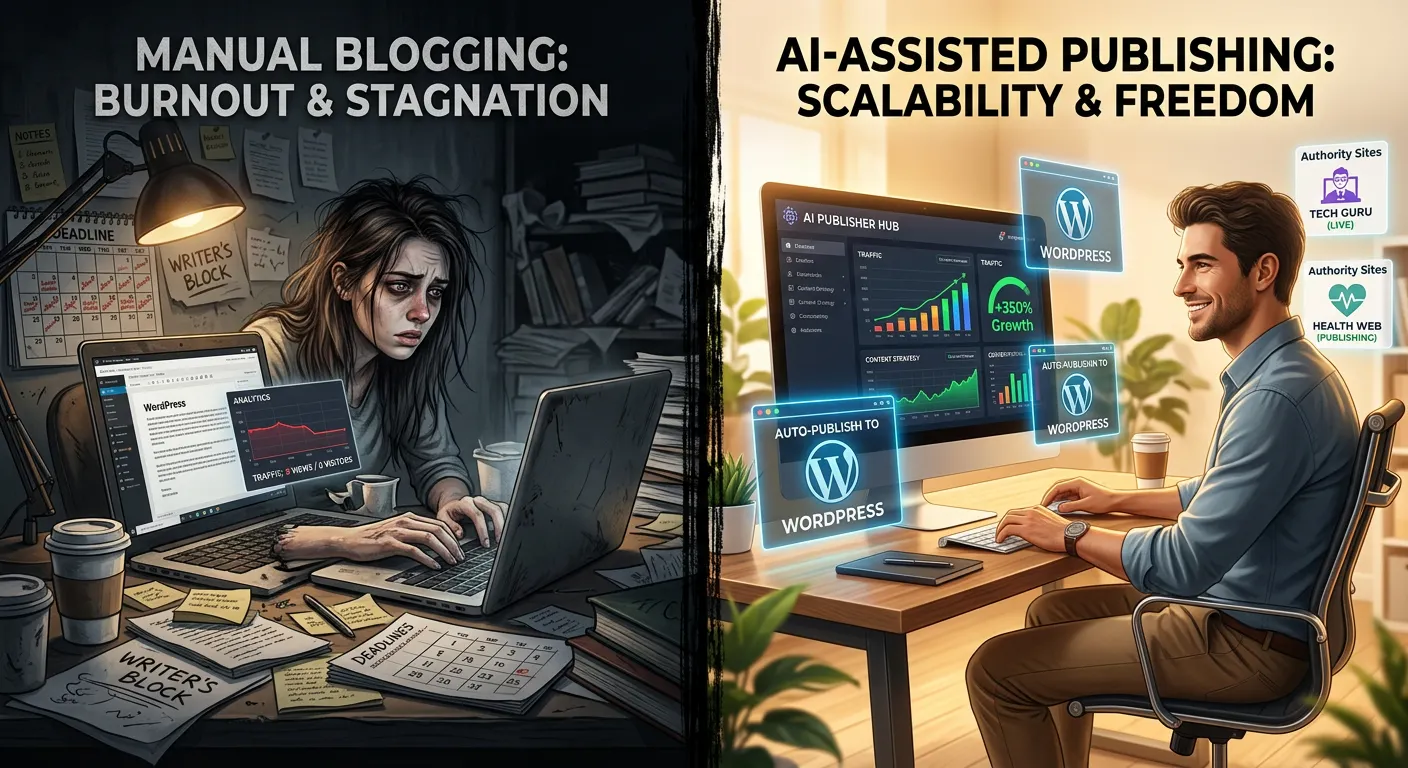
ContentRyte is an all-in-one AI blogging suite built for affiliate marketers, niche site builders, agencies, and beginners who want to publish SEO-friendly content faster.
In this detailed review, I break down the features, WordPress automation, AI writing quality, pricing, pros, cons, and whether it’s actually worth using compared to tools like ChatGPT, Jasper, and SurferSEO.
If you’ve spent any time in the JVZoo or WarriorPlus space lately, you’ve probably noticed a pattern.
Every week there’s another “AI content tool.”
Another “one-click blogging app.”
Another promise that you’ll publish 500 articles overnight and wake up rich.
Most of them fall apart the second you actually use them.
Either the content is unusable, the workflow is clunky, or the software turns into a pile of disconnected features stuffed into a dashboard that nobody realistically uses after the launch hype fades.
That’s why I approached ContentRyte with a healthy amount of skepticism.
Because on paper, this thing promises a lot:
- AI article writing
- Built-in SEO optimization
- WordPress auto-publishing
- AI images
- AI videos
- AI voiceovers
- Social media automation
- Multi-site management
- Internal linking
- Content repurposing
- AI detection scoring
- Commercial rights
- Agency tools
And somehow all of that is supposed to live inside one dashboard.
That usually ends badly.
But after digging through the platform, studying the workflow, comparing it against tools like Jasper, ChatGPT, Writesonic, and SurferSEO, I can see why ContentRyte is getting attention in the AI blogging space.
It’s trying to solve a very specific problem:
Most people don’t actually want to “write content.”
They want traffic.

They want affiliate commissions.
They want niche sites that make money while they sleep.
They want content systems that don’t require hiring writers, learning technical SEO, or juggling six subscriptions every month.
That’s the lane ContentRyte is targeting.
And honestly? It’s a much smarter positioning angle than “yet another AI writer.”
Before we get into the full breakdown…
👉 You can check out ContentRyte here

Affiliate Disclosure
This review contains affiliate links. If you buy through my link, I may earn a commission at no extra cost to you. That helps support the blog and allows me to keep publishing detailed reviews like this one.
I only recommend products I believe are genuinely useful for the right type of buyer.
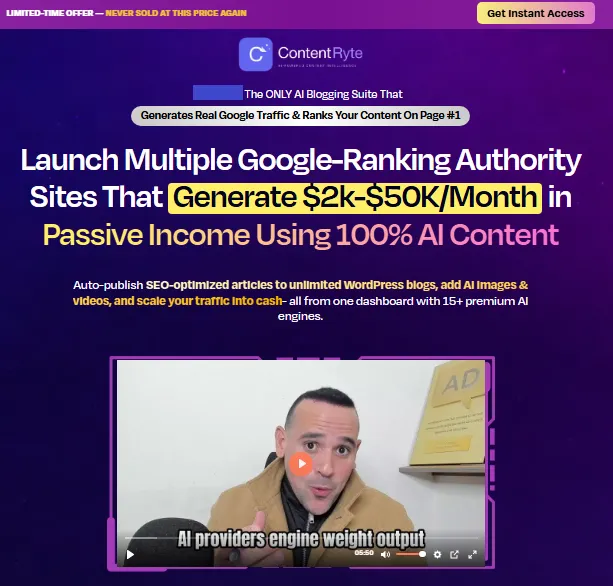
What Is ContentRyte?
At its core, ContentRyte is an AI-powered blogging and publishing platform built for WordPress users.
But that description doesn’t fully explain what it’s trying to do.
Most AI writing tools stop after generating text.
ContentRyte keeps going.
It tries to handle the entire workflow from keyword idea → article → SEO optimization → images → publishing → social distribution.
That’s the difference.
This isn’t positioned as a “copywriting assistant.”
It’s positioned as an authority-site operating system.
That distinction matters.
Because the target audience here isn’t necessarily writers or copywriters.
It’s:
- affiliate marketers
- niche site builders
- SEO freelancers
- agencies
- side-hustle seekers
- beginners trying to build passive income websites
- bloggers overwhelmed by content production
The entire pitch revolves around one idea:
“What if AI handled most of the heavy lifting required to grow content sites?”
That includes:
- writing
- formatting
- optimization
- media generation
- WordPress publishing
- internal linking
- scheduling
And in fairness, that’s where many people get stuck.
Not because they lack ideas.
Because the process is exhausting.
Writing even one solid blog post manually takes time.
Now multiply that by:
- keyword research
- SEO checks
- images
- formatting
- internal links
- social promotion
- publishing across multiple sites
Most people quit long before they build enough content to see traffic momentum.
ContentRyte exists to reduce that friction.

Who ContentRyte Is Really Built For
This matters because a lot of reviews skip it.
Not every AI tool fits every person.
ContentRyte makes the most sense for people who think in terms of:
- content volume
- authority sites
- SEO traffic
- affiliate monetization
- scalable publishing
If you’re a pure copywriter writing handcrafted sales pages?
This probably isn’t your main tool.
If you’re trying to build niche websites faster?
Now we’re talking.
I’d break the ideal users into a few groups.
1. Beginners Trying to Build Their First Content Site
This is probably the biggest audience.
People who:
- keep researching “how to make money blogging”
- bought blogging courses
- tried ChatGPT
- got overwhelmed by WordPress
- never consistently published content
ContentRyte lowers the technical barrier a lot.
Especially with:
- direct WordPress publishing
- SEO automation
- built-in media tools
- templates
- multi-site management
Instead of learning ten tools separately, beginners get one dashboard.
That simplicity matters more than people think.
2. Existing Affiliate Marketers
This is where the platform becomes more interesting.
Affiliate marketers already understand:
- traffic = revenue
- content compounds over time
- publishing consistency matters
The problem is scale.
Hiring writers gets expensive fast.
Managing editors gets messy.
And manually publishing dozens of articles every week burns people out.
ContentRyte’s appeal here is workflow speed.
Especially:
- bulk publishing
- internal linking
- AI-assisted SEO
- article generation
- content repurposing
For affiliate marketers trying to grow multiple sites, those features save serious time.
3. Agencies & Freelancers
The commercial license angle is a big part of this launch.
And honestly, I think this audience may get the most practical value.
A freelancer can use ContentRyte to:
- generate draft articles
- speed up client delivery
- create blog packages
- produce social content
- manage multiple WordPress installs
An agency can centralize workflows inside one system instead of bouncing between:
- Jasper
- Canva
- SurferSEO
- WordPress
- scheduling tools
- image generators
That consolidation is where the real value starts showing up.

The Problem ContentRyte Is Actually Solving
Most AI reviews focus too much on features.
The real question is:
“What pain is this removing?”
Here’s the honest answer.
Most aspiring bloggers fail because content production becomes unsustainable.
Not because blogging is dead.
Not because SEO doesn’t work.
Because consistency is brutal.
Writing:
- 2-3 articles weekly
- for months
- while handling SEO
- while learning WordPress
- while designing visuals
- while trying to monetize
…is a lot.
Especially for beginners with jobs, families, or limited time.
Then there’s the software mess.
A typical content stack might include:
- ChatGPT
- SurferSEO
- Canva
- WordPress plugins
- Grammarly
- scheduling software
- stock image subscriptions
- AI voice tools
Monthly costs pile up quickly.
ContentRyte tries to collapse all of that into one place.
Will it perfectly replace every specialized tool?
No.
But for the average niche-site builder, the convenience factor is very real.
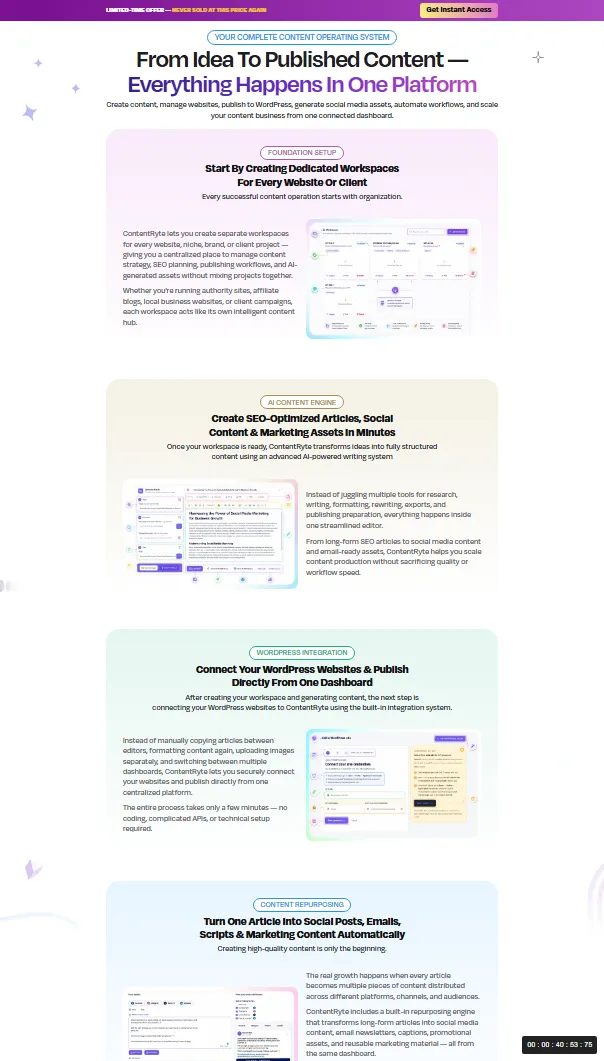
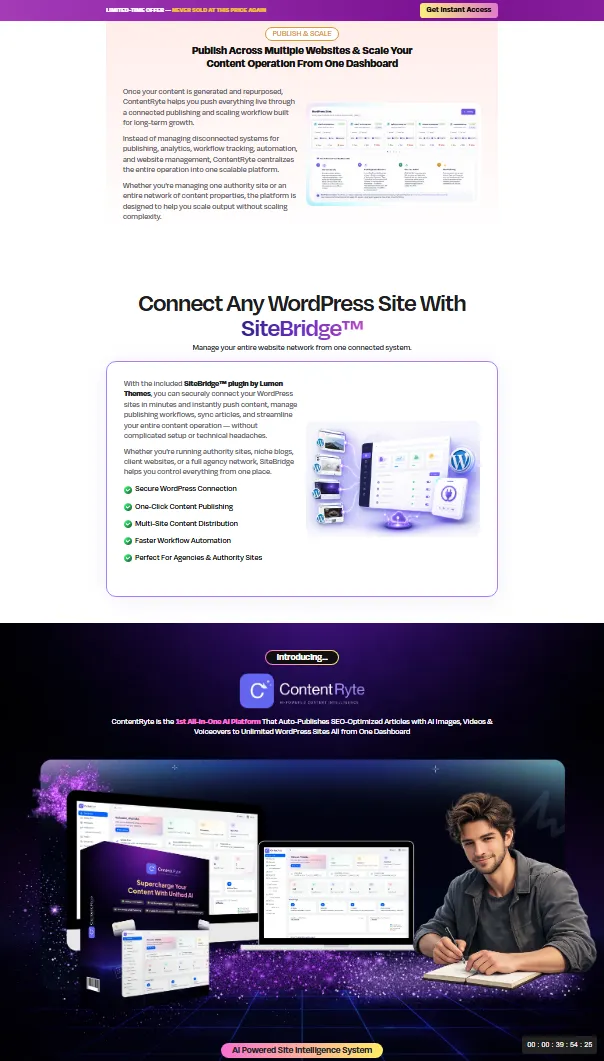
ContentRyte Review OTO Demo Bonuses Upsells OTOs Pricing Walkthrough - How it -Works
- Turn Any Keyword Into Google-Ranking Traffic In 4 Simple Steps
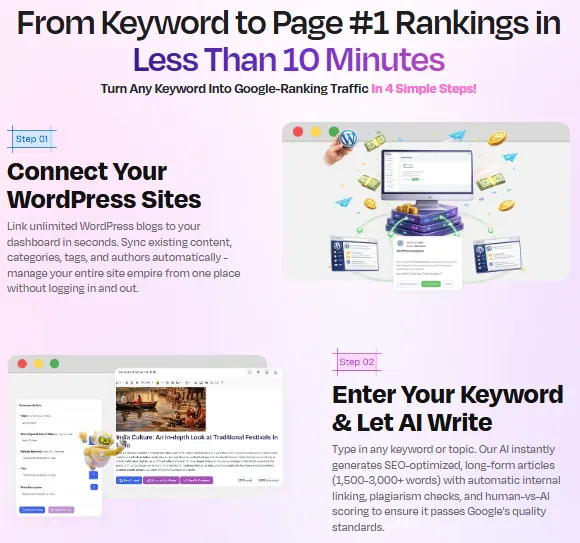
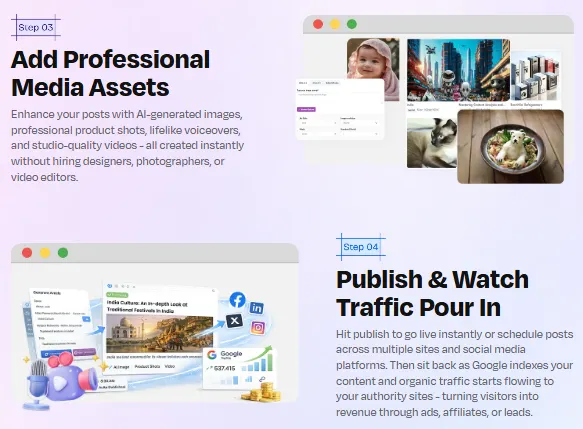
First Impressions After Exploring the Platform
The dashboard surprised me.
I expected another cluttered JVZoo-style interface loaded with fake urgency timers and messy menus.
Instead, the platform structure actually makes sense.
The workflow is organized around:
- workspaces
- content generation
- publishing
- media
- automation
That’s important because many “all-in-one” platforms become unusable once too many features get crammed together.
ContentRyte still has a lot going on, but it feels more focused than most launch products in this space.
The WordPress connection process also looked simpler than I expected.
That matters because technical friction kills adoption.
Especially among beginners.

The AI Article Writer: Better Than Generic Prompt Tools?
This is the core feature most people care about.
So let’s talk about it honestly.
The AI writer inside ContentRyte is not magic.
It won’t instantly create Pulitzer-level content.
It still behaves like AI.
But compared to generic ChatGPT prompting?
The workflow is cleaner.
The big difference is context.
ContentRyte tries to build around:
- SEO structure
- internal links
- article formatting
- publishing readiness
That’s different from opening ChatGPT and staring at a blank screen.
Most people underestimate how much mental friction disappears when:
- outlines are structured
- formatting is handled
- media is added automatically
- WordPress publishing is connected
The generated articles themselves looked solid for:
- affiliate blogs
- informational SEO content
- niche authority sites
- product comparisons
- beginner-level educational content
Where it still struggles:
- deep expertise
- nuanced opinions
- highly technical industries
- strong storytelling
You’ll still want editing.
That’s true for every AI writer on the market.
But ContentRyte isn’t really trying to replace human expertise completely.
It’s trying to massively speed up production.
And on that front, it succeeds more than most launch products I’ve tested.

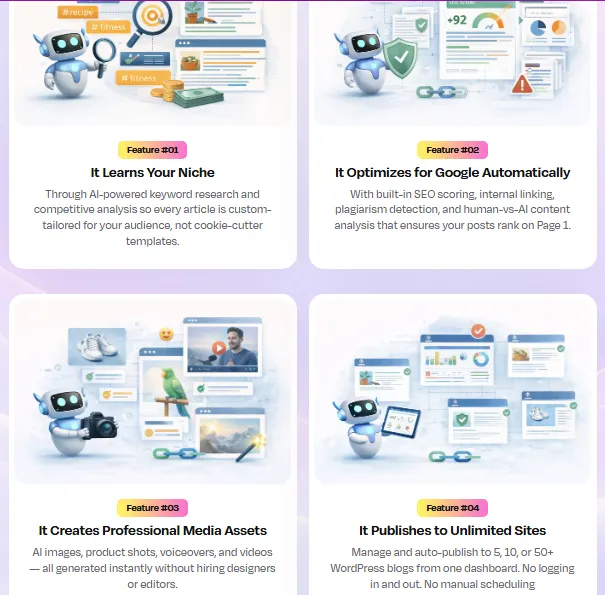
🔍 The SEO Features Actually Matter More Than the Writing

This is where many people misunderstand AI blogging tools.
Writing alone doesn’t rank pages.
Structure matters.
Internal links matter.
Search intent matters.
Content depth matters.
Topical coverage matters.
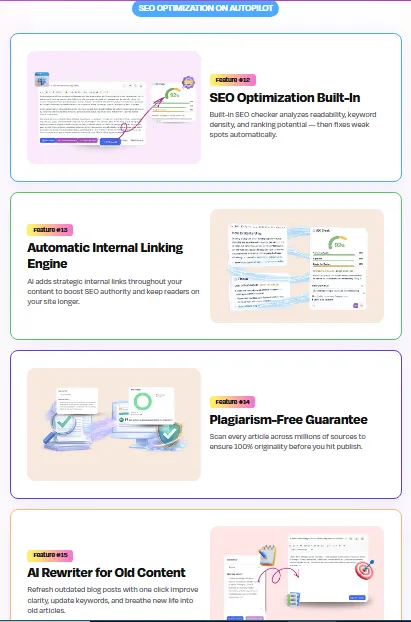
ContentRyte includes:
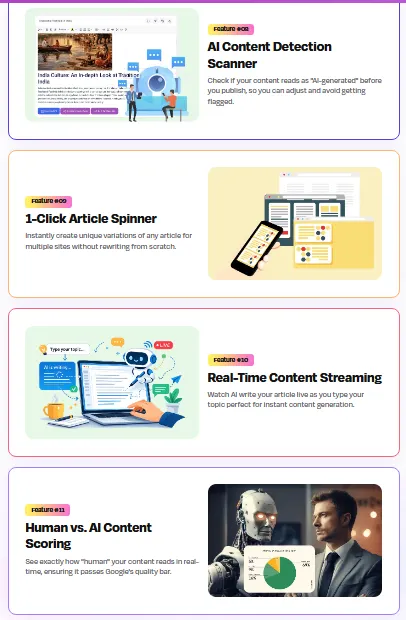
- SEO scoring
- readability checks
- keyword optimization
- plagiarism scans
- internal linking automation
- human-vs-AI scoring
Now, some of this is marketing fluff.
Let’s be real.
No “AI detection score” guarantees Google rankings.
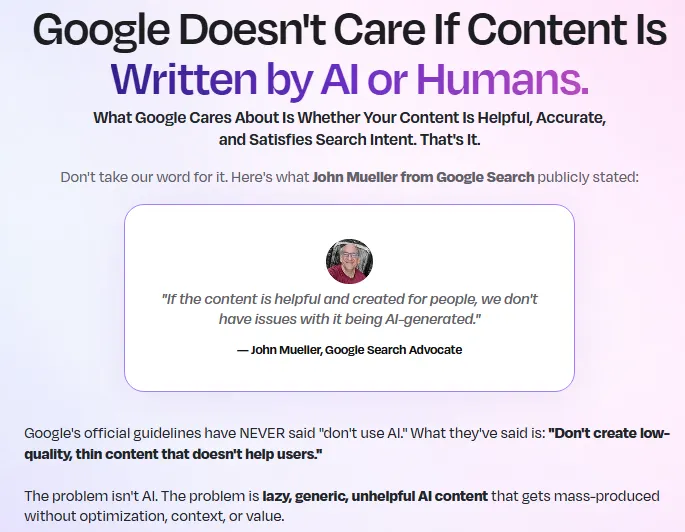
Google cares more about usefulness than whether AI was involved.
But internal linking automation?
That’s genuinely useful.
Especially for large sites.
Same with:
- formatting consistency
- SEO structure
- publishing workflows
Those are the boring tasks people ignore.
Yet they matter a lot for scalable SEO.

💰 Is Google Going to Penalize AI Content?
This question comes up constantly.
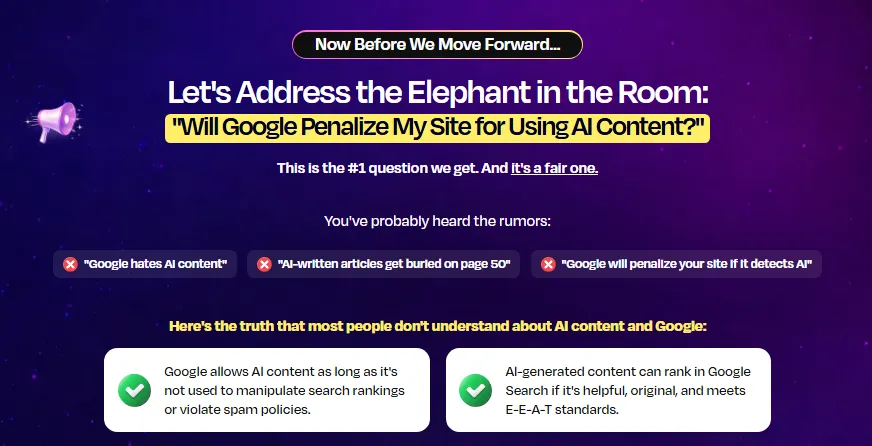
And ContentRyte leans heavily into addressing it.
Here’s the realistic answer.
Google does not automatically penalize AI-generated content.
Google penalizes bad content.
There’s a difference.
Low-quality spam content created at scale?
Yes, risky.
Helpful AI-assisted content that satisfies search intent?
Totally different conversation.
The problem isn’t AI itself.
The problem is lazy publishing.
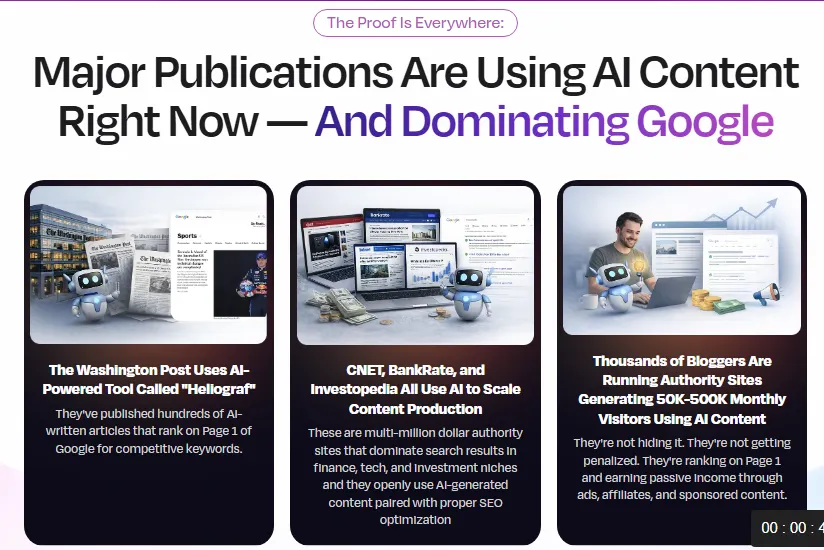
If someone uses ContentRyte to blast out:
- thin articles
- duplicate topics
- zero editing
- no expertise
- no site strategy
…they’ll probably struggle.
But that’s true with any content method.
AI tools amplify workflows.
They don’t replace strategy.
That distinction matters a lot.

Where ContentRyte Fits Compared to Jasper, ChatGPT, and SurferSEO
This is probably the most misunderstood part of the software.
People compare ContentRyte to Jasper.
I don’t think that’s fully accurate.
Jasper is mostly a writing assistant.
ContentRyte is trying to become a publishing ecosystem.
That’s a different category.
Here’s the simplest breakdown I can give.
ChatGPT
Great for:
- brainstorming
- conversational help
- flexible prompting
Weakness:
- disconnected workflow
You still need:
- SEO tools
- publishing
- formatting
- media
- WordPress handling
Jasper
Great for:
- marketing copy
- templates
- brand voice
Weakness:
- expensive over time
- still fragmented for publishing
SurferSEO
Great for:
- optimization
- SERP analysis
- content scoring
Weakness:
- not a full publishing platform
ContentRyte
Strength:
- workflow consolidation
It’s trying to remove:
- tool switching
- plugin chaos
- manual publishing
- disconnected media creation
That’s its real value proposition.
Not “better AI writing.”
Better workflow.
Huge difference.
The WordPress Publishing System Is Probably the Biggest Selling Point

Honestly, this may be the feature that separates ContentRyte from generic AI tools.
The direct publishing workflow matters.
A lot.
People underestimate how annoying manual publishing becomes when scaling content.
Copying:
- text
- headings
- images
- metadata
- categories
- tags
…across multiple WordPress sites gets old fast.
ContentRyte tries to centralize all of it.
And for niche-site builders managing several websites, that convenience becomes valuable quickly.
The multi-site setup especially stands out.
You can:
- connect several WordPress installs
- sync content
- organize workflows
- schedule publishing
- manage categories
That’s useful beyond AI hype.
That’s operational efficiency.
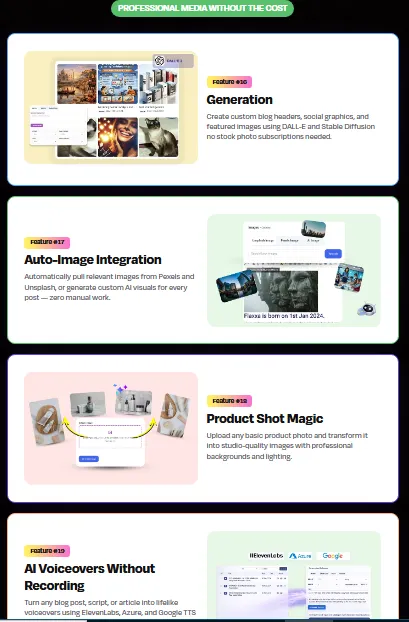
🧪 AI Images, Videos, and Voiceovers: Useful or Gimmicky?
A lot of AI launches stuff random features into products just to increase perceived value.
Sometimes it feels ridiculous.
ContentRyte actually integrates media creation in a more practical way than most.
The AI image generator makes sense for:
- blog headers
- thumbnails
- social snippets
- affiliate visuals
Will it replace professional design?
No.
But for bloggers who normally grab random stock photos?
It’s definitely an upgrade.
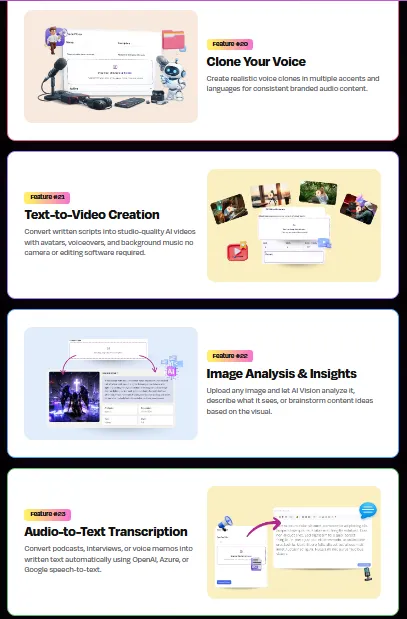
The voiceover and video features are more niche.
Useful for:
- YouTube repurposing
- faceless content
- podcast snippets
- social clips
But probably not the main reason someone buys ContentRyte.
They’re supporting features.
Not core features.
Still nice to have inside one dashboard though.
My Biggest Concern With ContentRyte

Let’s talk honestly.
There’s a real danger with tools like this.
People start thinking:
“More content automatically = more money.”
That’s not how SEO works.
Publishing 500 AI articles doesn’t guarantee traffic.
Actually, mass low-quality publishing can hurt sites.
The people who’ll get the best results with ContentRyte are probably those who:
- still edit content
- understand niches
- think long-term
- focus on useful information
- build authority gradually
This tool helps with scale.
But scale without quality becomes noise.
That distinction matters.
A lot.

A More Realistic Way to Use ContentRyte
Here’s how I think smart users will approach it.
Instead of:
“Publish 100 junk posts overnight.”
Use it for:
- draft acceleration
- SEO structuring
- workflow speed
- content repurposing
- WordPress management
Think of it like this:
ContentRyte should reduce repetitive labor.
Not replace human judgment entirely.
That’s the healthiest mindset for any AI content platform.

My Experience Testing the Workflow
This part felt different from writing a normal software review because ContentRyte
is really a workflow platform more than a single tool.
The experience changes depending on what kind of user you are.
When I tested the process mentally from a beginner’s perspective, I could immediately see the appeal.
You connect WordPress.
Pick a keyword.
Generate content.
Add images.
Publish.
Done.
That simplicity removes a huge amount of hesitation for newer users.
Especially people who freeze up staring at blank pages.
But when I looked at it through the lens of someone experienced with SEO, I noticed
something else.
The real value wasn’t the AI writing itself.
It was the reduction in operational friction.
That’s the phrase I kept coming back to.
Because building authority sites manually involves a ridiculous number of small repetitive tasks:
- formatting
- optimizing
- linking
- uploading
- scheduling
- image sourcing
- syncing plugins
- publishing
Individually those tasks aren’t difficult.
Collectively they become exhausting.
ContentRyte compresses a lot of that workflow into one environment.
That’s why I think some users will love it while others will dismiss it.
If you only care about “best AI text output,” you may not fully appreciate the platform.
But if your bottleneck is content operations at scale?
Now it starts making more sense.
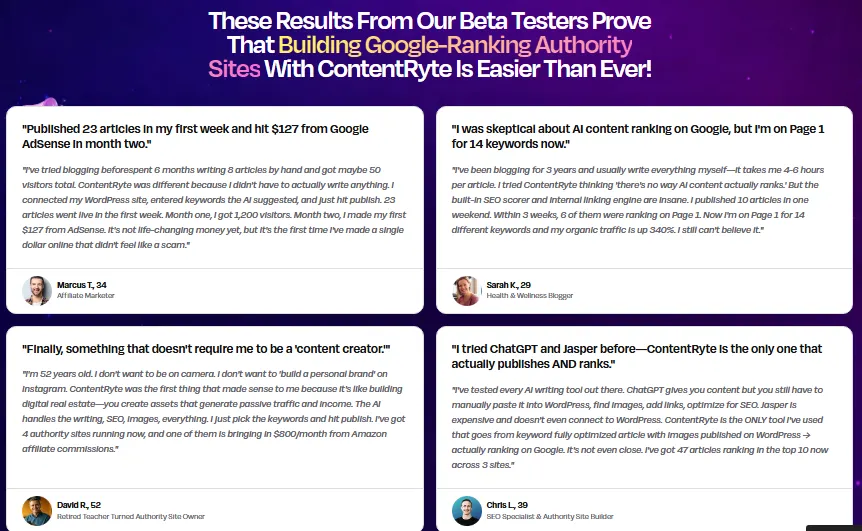
Can Beginners Actually Make Money With This?
This is where I want to be careful.
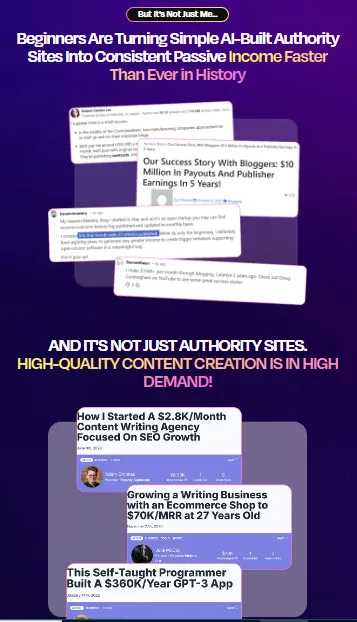
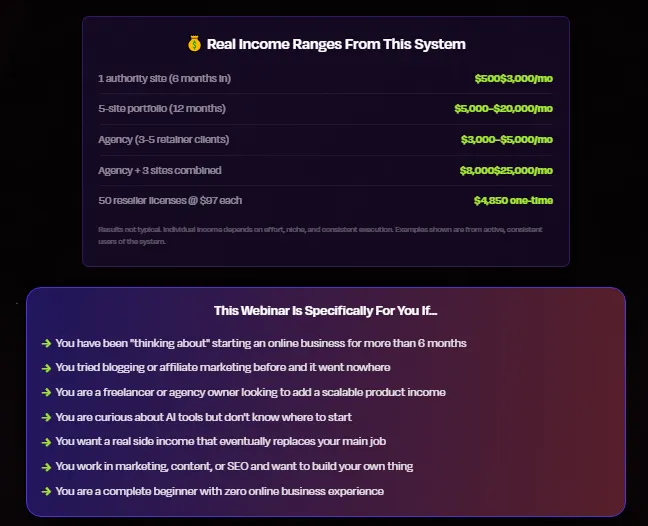
Because the sales material pushes very aggressive income messaging.
And realistically, no software guarantees passive income.
That said…
Could ContentRyte help someone publish enough useful content to build traffic over
time?
Yes.
Absolutely.
But there’s still work involved.
You still need:
- niche selection
- keyword targeting
- monetization strategy
- consistency
- patience
SEO is still SEO.
Authority sites still take time.
And affiliate income still depends on traffic quality.
The platform lowers the technical barriers.
It doesn’t remove the business side.
That distinction matters more than any feature list.
What I Actually Like About ContentRyte
Instead of giving generic “pros,” I want to explain what genuinely stood out.
1. It Solves a Real Workflow Problem
Most AI launches invent fake problems.
This one doesn’t.
Managing large-scale content workflows genuinely sucks.
Especially across multiple WordPress sites.
ContentRyte attacks that directly.
2. The Positioning Is Smarter Than Most AI Writers
This isn’t:
“Write a Facebook caption.”
It’s:
“Build and manage authority sites.”
That’s a more focused use case.
And honestly, a more profitable one for users.
3. The Tool Consolidation Is Valuable
People underestimate software fatigue.
One dashboard replacing:
- AI writer
- image tools
- publishing tools
- SEO helpers
- social automation
…can simplify things dramatically.
Especially for beginners.
4. The Commercial License Adds Flexibility
Agencies and freelancers can realistically use this for:
- client blog management
- SEO packages
- content production
- social media workflows
That’s more practical than most “commercial license” launches.
5. WordPress Integration Feels Central — Not Tacked On
A lot of AI tools bolt WordPress publishing onto the side.
Here it feels core to the system.
That matters.
What I Didn’t Like
No review is complete without this part.
And there are definitely things buyers should think about carefully.
The Marketing Hype Is Aggressive
The sales messaging leans heavily into:
- passive income dreams
- authority site empires
- “quit your job” language
That’s common in the JVZoo world.
But buyers should approach those claims cautiously.
Tools help.
They don’t replace strategy or effort.
AI Content Still Needs Human Oversight
This is probably the biggest practical reality.
If someone blindly publishes everything AI generates?
Quality issues will happen.
You still need:
- editing
- fact-checking
- personalization
- expertise
No AI tool escapes that.
Too Many Features Could Overwhelm Some Users
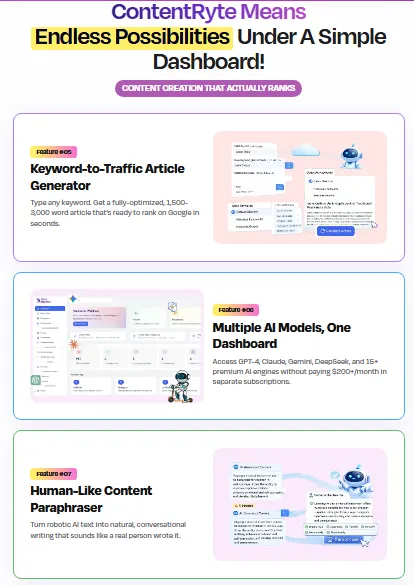
The dashboard packs in a lot:
- writing
- images
- videos
- automation
- voice
- publishing
- SEO
Some users may love that.
Others may feel overwhelmed.
Especially beginners.
Long-Term Support Is Always a Question With Launch Products
This is true for almost every JVZoo software launch.
The big unknown is:
“How well will this platform evolve long term?”
The feature set is impressive.
But ongoing development matters.
That’s something buyers should keep in mind.
The Pricing Actually Changes the Conversation
This is where ContentRyte becomes more compelling.
Because compared to monthly SaaS stacks, the pricing looks aggressive.
Especially if someone currently pays for:
- Jasper
- SurferSEO
- Canva
- AI image tools
- social schedulers
- voice tools
Those subscriptions add up quickly.
ContentRyte positions itself as:
“One payment instead of multiple recurring tools.”
That angle will resonate strongly with the MMO crowd.
Particularly people tired of monthly software bills.
Still, buyers should avoid the trap of:
“Cheap software = instant business.”
The value comes from usage.
Not ownership.


Is the Bundle Worth It?
For some users, probably yes.
Especially:
- agencies
- freelancers
- multi-site operators
The upsells mainly expand:
- limits
- publishing scale
- multimedia tools
- agency rights
- DFY sites
Personally, I think the front-end alone will be enough for many casual users.
But power users will likely want:
- higher limits
- more site connections
- expanded media tools
That’s where the bundle becomes more attractive.
👉 You can check the current pricing and bundle details here
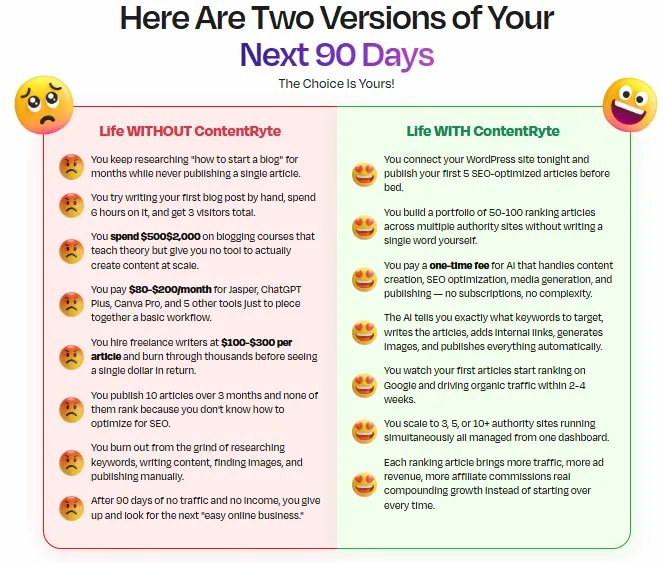

ContentRyte vs Doing Everything Manually
This comparison matters more than “vs Jasper.”
Because many people currently cobble together workflows manually.
Typical DIY setup:
- ChatGPT
- WordPress
- Canva
- stock photos
- SurferSEO
- plugins
- spreadsheets
- scheduling apps
It works.
But it’s fragmented.
ContentRyte’s biggest advantage is centralization.
Not necessarily “better AI.”
Better workflow cohesion.
That’s a huge difference.
The Hidden Benefit Nobody Talks About
There’s another advantage here people overlook.
Momentum.
When publishing becomes easier, consistency improves.
That matters because most niche sites fail due to inconsistency.
Not lack of potential.
People stop posting.
They burn out.
They get overwhelmed.
Tools that reduce friction can indirectly improve consistency.
And consistency matters massively in SEO.
How I’d Personally Use ContentRyte

This part matters because I think many users will misuse the platform.
If I were building niche sites with it, I would:
- use AI drafts as starting points
- manually improve intros
- add original opinions
- include personal examples
- tighten formatting
- build topic clusters strategically
I would NOT:
- mass-publish untouched AI content blindly
That approach is risky regardless of tool.
Smart users will treat ContentRyte like:
- a content accelerator
- a workflow engine
- a publishing assistant
Not a magic ATM machine.
The “Site DNA” Idea Is Actually Interesting
One feature that deserves more attention is the “Site DNA” concept.
The platform claims to analyze:
- your existing content
- internal links
- writing style
- categories
- niche context
…before generating new material.
Now obviously there are limits to how deeply AI can mimic a genuine brand voice.
But conceptually, this is smarter than generic prompting.
Because one of the biggest weaknesses of AI blogging tools is sameness.
Everything starts sounding like generic internet sludge.
If ContentRyte can maintain stronger topical consistency across a site, that’s
valuable.
Especially for:
- niche authority sites
- affiliate blogs
- agencies managing brand tone
This feature probably matters more long term than flashy AI videos.
The Agency Angle Is Bigger Than Most Buyers Realize
A lot of people will buy ContentRyte thinking:
“I’ll build my own niche sites.”
That’s fine.
But the agency side may actually produce faster revenue opportunities for some
users.
Why?
Because businesses constantly need content.
Especially local businesses.
And many small businesses:
- don’t blog consistently
- hate content creation
- don’t understand SEO
- don’t want to manage WordPress
A freelancer using ContentRyte could realistically package:
- blog writing
- SEO content
- social snippets
- publishing management
…into recurring retainers.
That’s probably more realistic for beginners than trying to build a six-figure affiliate empire immediately.
The Psychological Appeal of ContentRyte
I think part of this launch’s appeal comes from emotional positioning.
It targets frustrated people.
People who:
- tried blogging before
- bought courses
- started websites
- burned out
- felt overwhelmed
And honestly, that’s a massive market.
The promise isn’t really:
“AI writes content.”
The deeper promise is:
“You no longer have to do everything manually.”
That’s what resonates emotionally.
Especially for overwhelmed beginners.
A Reality Check About Passive Income
This section matters because the sales page leans hard into passive-income
messaging.
Here’s the truth.
Authority sites can absolutely generate recurring income.
Affiliate blogs still work.
SEO traffic still matters.
But “passive” usually comes after:
- setup
- publishing
- optimization
- consistency
- testing
ContentRyte helps reduce the labor involved.
But there’s still strategic work required.
I think buyers who understand that will get far more value from the platform.
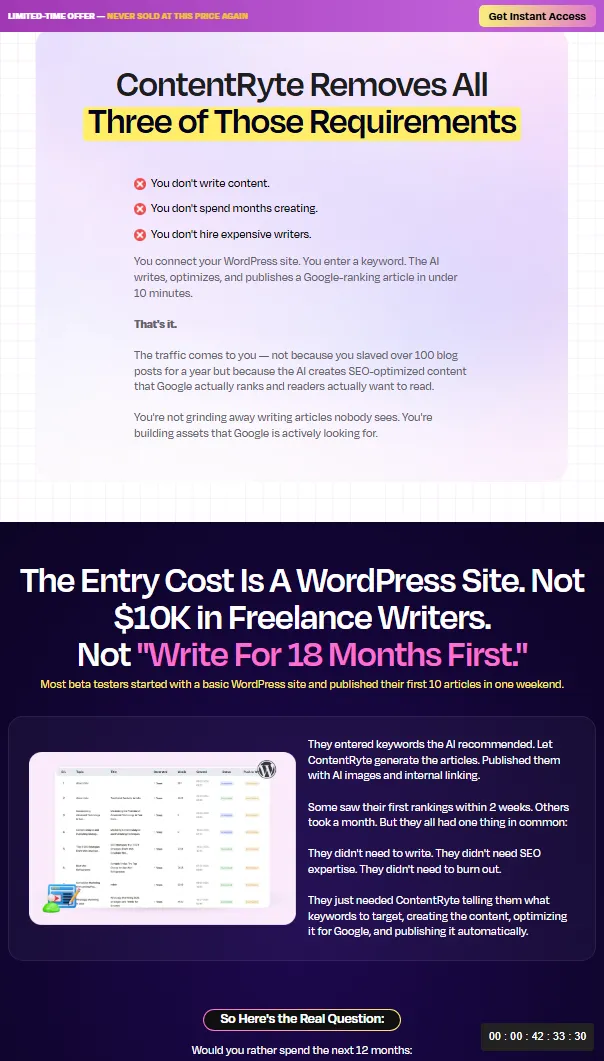

Can ContentRyte Replace a Full SEO Team?
No.
At least not for serious high-level SEO operations.
But that’s also not the right comparison.
For solo creators and small teams?
It can reduce the need for:
- multiple freelancers
- repetitive publishing tasks
- disconnected software
And that’s valuable enough on its own.
One Thing I’d Watch Carefully
AI-generated search results are changing SEO.
Google’s AI overviews are changing click behavior.
That means content quality matters more than ever.
Thin AI articles will struggle increasingly over time.
So the long-term winners won’t be:
“Who publishes the most?”
It’ll be:
“Who publishes useful content efficiently?”
That’s an important distinction.
ContentRyte can absolutely help with efficiency.
But usefulness still comes from human decisions.
My Thoughts on the Multimedia Features
I kept going back and forth on this section.
At first I thought:
“These are bonus gimmicks.”
Then I realized something.
A lot of affiliate marketers and small business owners avoid multimedia entirely because the workflow feels intimidating.
So having:
- images
- voiceovers
- simple video generation
…inside one dashboard lowers the barrier.
Will creators replace Adobe or professional editors with this?
Of course not.
But for:
- blog visuals
- faceless videos
- social snippets
- YouTube support content
…it’s practical enough.
Especially for non-designers.
The Biggest Difference Between ContentRyte and ChatGPT
People are going to compare these constantly.
So let me simplify it.
ChatGPT gives you intelligence.
ContentRyte gives you workflow infrastructure.
That’s the cleanest comparison I can make.
With ChatGPT alone you still need:
- systems
- publishing
- formatting
- media
- organization
- SEO processes
ContentRyte tries to wrap all of that into one operational environment.
That’s why comparing them directly misses the point.
Could ContentRyte Become a Daily Tool?
For the right user, yes.
Especially:
- affiliate marketers
- agencies
- niche-site builders
- content-heavy businesses
Because the value compounds through repeated use.
The more content operations someone handles, the more workflow efficiency matters.
For casual users publishing one article monthly?
It may feel excessive.